What if you invested in Berkshire Hathaway in 2000?
BRK-B · Financial · Data through 2026-09-01
If you invested $1,000 in Berkshire Hathaway in 2000
The same $1,000 in the S&P 500 would be worth $8,740(+774%)
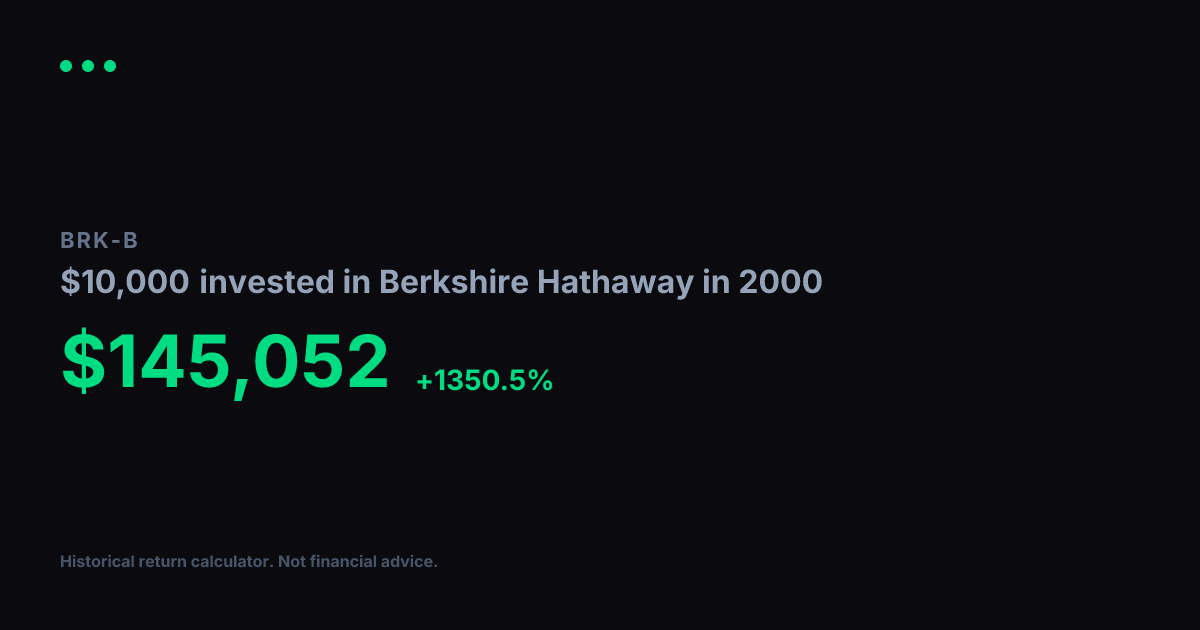
The S&P 500 returned $8,740 on the same $1,000. Berkshire Hathaway beat the market by $6,621.
Try a different start date
Pick any month and year to see what Berkshire Hathaway would be worth.
Compare Berkshire Hathaway to another stock
See how Berkshire Hathaway stacks up since 2000, head to head.
What if Berkshire Hathaway keeps this up?
Project forward at Berkshire Hathaway's 10.8% historical growth rate. See 5-30 year scenarios.
Growth of $1,000
Berkshire Hathaway vs. S&P 500 vs. US Dollar, 2000 to present
Year-by-Year Returns
$1,000 invested in Berkshire Hathaway starting January 2000
| Year | Price | Value | Annual |
|---|---|---|---|
| 2000 | $32.92 | $1,000 | - |
| 2001 | $45.00 | $1,367 | +36.7% |
| 2002 | $49.06 | $1,490 | +9% |
| 2003 | $44.48 | $1,351 | -9.3% |
| 2004 | $59.62 | $1,811 | +34% |
| 2005 | $59.88 | $1,819 | +0.4% |
| 2006 | $58.64 | $1,781 | -2.1% |
| 2007 | $73.35 | $2,228 | +25.1% |
| 2008 | $91.00 | $2,764 | +24.1% |
| 2009 | $59.78 | $1,816 | -34.3% |
| 2010 | $76.43 | $2,322 | +27.9% |
| 2011 | $81.75 | $2,483 | +7% |
| 2012 | $78.37 | $2,381 | -4.1% |
| 2013 | $96.93 | $2,944 | +23.7% |
| 2014 | $111.60 | $3,390 | +15.1% |
| 2015 | $143.91 | $4,372 | +29% |
| 2016 | $129.77 | $3,942 | -9.8% |
| 2017 | $164.14 | $4,986 | +26.5% |
| 2018 | $214.38 | $6,512 | +30.6% |
| 2019 | $205.54 | $6,244 | -4.1% |
| 2020 | $224.43 | $6,817 | +9.2% |
| 2021 | $227.87 | $6,922 | +1.5% |
| 2022 | $313.02 | $9,509 | +37.4% |
| 2023 | $311.52 | $9,463 | -0.5% |
| 2024 | $383.74 | $11,657 | +23.2% |
| 2025 | $468.67 | $14,237 | +22.1% |
| 2026 | $480.53 | $14,597 | +2.5% |
What this return means
Holding Berkshire Hathaway (BRK-B) from 2000 multiplied a $1,000 stake into $15,362. That works out to +1436.2%, about 15x the original stake, as of 2026-09-01.
That is about 10.8% a year compounded, broadly in line with long-run stock market averages. The same $1,000 in an S&P 500 index fund over the same span would be about $8,740, so Berkshire Hathaway beat the index by roughly $6,621. The index compounded at about 8.4% a year over that period.
The path was not smooth. The best single year was 2022 at +37.4%, and the worst was 2009 at -34.3%. At its lowest point the position was down about 34% from an earlier high. These figures use split-adjusted closing prices and exclude dividends, taxes, trading fees, and inflation, so a real after-tax result would differ.
This is historical math, not financial advice. Past performance does not guarantee future results.
What if you invested $100 a month instead?
Most people do not drop a lump sum in on day one. They add a fixed amount every month. Putting $100 into Berkshire Hathaway at the close of every month from January 2000 through September 2026 means 321 buys and $32,100 contributed over about 26.8 years.
$100/month, dollar-cost averaged
$173,653
+441.0% on $32,100 in
Same $32,100, all in at the start
$493,113
+1,436.2% on $32,100 in
Going all in at the start beat spreading the buys out by $319,460. That is the usual result when a stock trends up: each monthly buy pays a higher price than the last, so the average cost climbs. Averaging in also meant an average buy price of $93.48 per share across the whole stretch, so the monthly buyer never had to time a single low. Neither number counts dividends, taxes, or trading costs.
Illustrative fixed $100/month example, not a recommendation. Figures are computed from BRK-B split-adjusted monthly closes through September 2026. Past performance does not guarantee future results.
Berkshire Hathaway at different times
See how the start year changes the outcome
Featured matchup
See this investment against its closest market rivals
More Financial investments
Compare returns across the sector
Numbers worth sharing
Occasional data drops when something interesting surfaces. No schedule, just signal.
For informational and educational purposes only. Not financial advice. Past performance does not guarantee future results. All calculations are based on split-adjusted closing prices from Yahoo Finance and do not account for dividends, taxes, or trading fees. See our methodology and full disclaimer.